
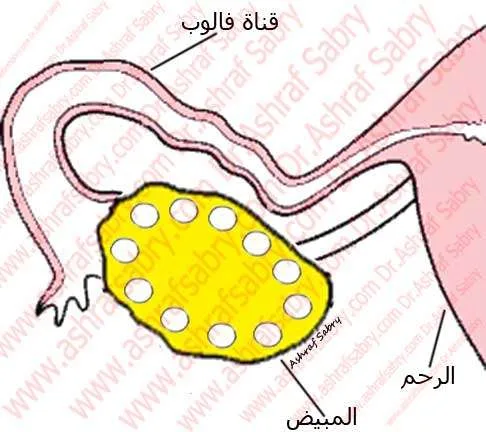
The two ovaries, one on each side of the pelvis near the end of each fallopian tube, are the source of eggs and female hormones, and are therefore central to fertility. Ovarian problems can prevent the release of a healthy egg ready for fertilization. Ovulation disorders account for about a quarter of female infertility.
Polycystic ovary syndrome (PCOS)
PCOS is the most common cause of absent ovulation. It involves raised LH, male hormones and insulin, and is diagnosed when at least two of the following are present: irregular or absent ovulation, signs of excess male hormones, and polycystic ovaries on ultrasound (or a raised AMH). See our full chapter on polycystic ovary syndrome.
Premature ovarian insufficiency
A woman is born with about one to two million egg follicles, around 300,000–400,000 remain at puberty, and the number falls steadily. In premature ovarian insufficiency (POI), ovarian function is lost before age 40, causing irregular or absent periods and infertility. Estrogen falls and FSH rises. Causes include genetic conditions (such as Turner syndrome and Fragile X premutation), autoimmune disease, pelvic surgery and chemotherapy or radiotherapy, though often no cause is found. Hormone replacement therapy is recommended until the natural age of menopause to protect the bones and heart. Some women still ovulate occasionally, so early assessment and prompt treatment give the best chance of conceiving.
Egg abnormalities
Some eggs have structural abnormalities, such as a thickened outer shell (zona pellucida), which can hinder fertilization or later hatching of the embryo. These problems are often only revealed during IVF, and ICSI bypasses most fertilization problems.
Luteal phase deficiency
After ovulation, the remaining follicle becomes the corpus luteum, which produces progesterone to prepare the uterine lining for implantation. It was once thought that insufficient progesterone was a common cause of infertility. Current evidence shows there is no reliable test to diagnose it, and ASRM no longer considers it an independent cause of infertility; progesterone support is, however, routinely given after IVF embryo transfer.
Functional cysts
Sometimes a follicle fails to release its egg at ovulation, because of hormonal imbalance, and continues to grow into a functional cyst. This can disturb ovarian function for a while. Most functional cysts resolve on their own within one to three cycles.
Luteinized unruptured follicle
In this condition, the follicle matures but the egg stays trapped inside instead of being released.
Resistant ovary syndrome
Rarely, the ovaries contain follicles but do not respond to FSH and LH from the pituitary or to fertility drugs, for reasons that are not fully understood.

Tests to confirm ovulation
Regular periods
Regular cycles between 21 and 35 days, varying by only a few days from month to month, usually indicate ovulation, but are not proof on their own.
Symptoms of ovulation
Some women feel one-sided lower abdominal pain at mid-cycle around ovulation, sometimes with slight spotting. This is supportive but not proof of ovulation.
Ultrasound follicle tracking
Transvaginal ultrasound shows the follicle as a dark, round structure in the ovary that grows by about 1.5–2 mm a day. When it disappears or collapses, ovulation has occurred, and a small amount of fluid released from the follicle may be seen behind the uterus.

Mid-luteal progesterone
A blood test about seven days before the expected period (day 21 of a 28-day cycle) is the standard test: a raised progesterone level confirms that ovulation has occurred, because progesterone is produced by the corpus luteum after the egg is released.
Ovulation predictor kits
Urine test strips detect the LH surge 24–36 hours before ovulation, helping couples time intercourse.
Basal body temperature
Temperature taken every morning before getting up rises slightly after ovulation under the effect of progesterone and stays higher until the period. This method is no longer recommended for diagnosis, because it is unreliable, it only shows ovulation after it has happened, and temperature can rise for other reasons such as infections.

Cervical mucus
Cervical mucus changes through the cycle under hormonal influence: scanty and thick after a period, then abundant, clear, slippery and stretchy in the days before ovulation, and thick again afterwards. Women can learn to recognize their fertile mucus to time intercourse. The cervix also rises, softens and opens slightly near ovulation. Microscopic examination of dried mucus (the “fern” pattern) was used in the past but is no longer needed.


Treatment of ovarian causes
- Absent or irregular ovulation: ovulation induction, with letrozole first-line in PCOS, and gonadotropin injections when needed. See ovarian stimulation and ovulation induction.
- Premature ovarian insufficiency: hormone replacement therapy to protect long-term health, with prompt fertility assessment if pregnancy is desired. Women at risk of early ovarian failure can consider egg freezing while ovarian reserve remains.
- Functional cysts: most resolve on their own, so they are usually monitored with repeat ultrasound. Surgery is reserved for cysts that persist, are large, cause symptoms or look complex, and should preserve as much healthy ovarian tissue as possible.
- Luteal support: progesterone is given after IVF transfer and in some stimulated cycles.

International Guidelines
In line with global standards, Dr. Sabry follows the latest recommendations from the American Society for Reproductive Medicine (ASRM), European Society of Human Reproduction and Embryology (ESHRE), and Royal College of Obstetricians and Gynaecologists (RCOG). Thus, patients receive care that is safe, ethical, and evidence-based.
Our Patient Reviews
Discover what patients say about us on Google Maps, Vezeeta, and WhatClinic.
Why Choose Dr. Ashraf Sabry?
Dr. Ashraf Sabry, consultant in obstetrics, gynecology, fertility, and aesthetic gynecology, is recognized among the best OBGYN and fertility specialists in Cairo. With over 20 years of experience, he combines science and compassion to provide world-class care. Book your appointment through the contact page, WhatsApp, or call +201022224442.