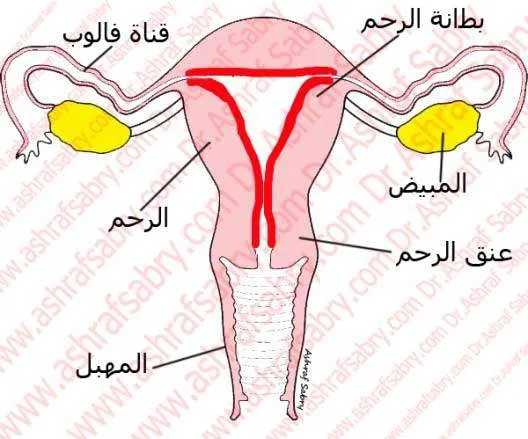
The menstrual cycle is a multi-step process that links several organs in the body.
FSH, released from the pituitary gland, stimulates a group of follicles in the ovary to grow. With the help of LH, also from the pituitary, the theca cells around each follicle convert cholesterol into androstenedione, which passes into the granulosa cells inside the follicle. Helped by FSH, the granulosa cells use the enzyme aromatase to convert it into estrogen.
The uterus is lined by a layer called the endometrium. At the start of a period (day 1 of the cycle), the lining is shed with some blood, which lasts 2–7 days. A thin base layer remains, which then multiplies and thickens under the influence of estrogen. Estrogen also changes the cervical mucus so that it allows sperm to pass into the uterus. For the uterus, this part of the cycle is called the proliferative phase.
At ovulation the mature egg leaves its follicle, and the remaining follicle becomes the corpus luteum, which produces progesterone. Progesterone completes the build-up of the lining and changes its structure so it is ready to receive and implant a fertilized egg. It also makes the cervical mucus thick, blocking sperm. If pregnancy does not occur, estrogen and progesterone levels fall and the lining breaks down and is shed as the next period. For the uterus, this second part of the cycle is called the secretory phase.
A normal cycle lasts 21–35 days in adults, counted from the first day of one period to the first day of the next, with bleeding usually lasting 3–7 days and a moderate flow. Cycles that are consistently shorter or longer than this, very irregular, or very heavy should be checked, as they can be a sign of ovulation problems.


International Guidelines
In line with global standards, Dr. Sabry follows the latest recommendations from the American Society for Reproductive Medicine (ASRM), European Society of Human Reproduction and Embryology (ESHRE), and Royal College of Obstetricians and Gynaecologists (RCOG). Thus, patients receive care that is safe, ethical, and evidence-based.
Our Patient Reviews
Discover what patients say about us on Google Maps, Vezeeta, and WhatClinic.
Why Choose Dr. Ashraf Sabry?
Dr. Ashraf Sabry, consultant in obstetrics, gynecology, fertility, and aesthetic gynecology, is recognized among the best OBGYN and fertility specialists in Cairo. With over 20 years of experience, he combines science and compassion to provide world-class care. Book your appointment through the contact page, WhatsApp, or call +201022224442.