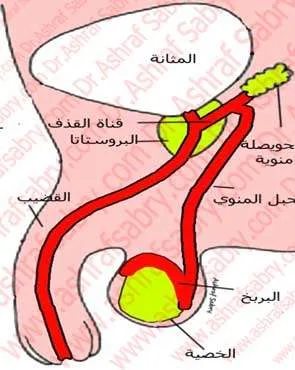
The male reproductive system is a group of organs responsible for producing sperm and delivering them for conception. It has internal and external parts.
Struggling to conceive? If natural conception is difficult in your case, IVF and ICSI with Dr. Ashraf Sabry may be the right solution. Learn about the steps, timing and who it suits.
The testes
The testes produce sperm and secrete testosterone. They sit in the scrotum below the penis, outside the body, because they need a slightly lower temperature than the rest of the body to produce sperm efficiently. Each testis is divided into lobules containing tightly coiled tubes called seminiferous tubules. Between the tubules lie the Leydig cells, which produce testosterone. The tubules are lined by Sertoli cells, between which immature sperm cells develop into mature sperm. It is normal for one testis to be slightly larger or to hang lower than the other.
The rete testis
The seminiferous tubules from each lobule join to form a network called the rete testis. From it, fine channels called efferent ductules carry sperm to the epididymis at the back of the testis.
The epididymis
The epididymis is a small structure about 5 cm long at the back of each testis, made of a single very fine tube 4–5 metres long, tightly coiled. Sperm mature as they pass through it; by the time they reach its end, they are able to swim and fertilize an egg.
The vas deferens
The epididymis continues as a thicker tube, the vas deferens, about 30 cm long and surrounded by muscle. These muscles contract during ejaculation to propel the sperm forward.
The ejaculatory ducts
Each vas deferens joins the duct of a seminal vesicle to form an ejaculatory duct, about 2 cm long, which passes through the prostate and opens into the urethra.
The seminal vesicles
The seminal vesicles produce the largest share of the seminal fluid, including fructose that fuels sperm.
The prostate gland
The prostate produces another part of the seminal fluid, which helps the semen liquefy after ejaculation.
The penis
The penis contains two cylinders of spongy erectile tissue (the corpora cavernosa) running along its length, and a third cylinder (the corpus spongiosum) through which the urethra runs. The erectile tissue fills with blood during arousal, causing an erection, and empties into the veins afterwards. The corpus spongiosum ends at the head of the penis (the glans), the most sensitive part because of its many nerve endings. The average adult penis is around 9 cm flaccid and 13 cm erect.
The urethra
The urethra runs through the corpus spongiosum and opens at the tip of the glans. It carries both urine and semen.
Sperm
Each sperm has a head, which carries the genetic material and is covered by a cap (acrosome) that helps it penetrate the egg; a midpiece, which provides energy; and a tail, which drives movement.
Semen
Semen is a mixture of secretions from the prostate and seminal vesicles with sperm from the testes. The World Health Organization’s latest manual (2021) gives the following lower reference limits for a fertile man:
- Volume: 1.4 mL or more
- Sperm concentration: 16 million per mL or more (total 39 million per ejaculate)
- Total motility: 42% or more; progressive motility: 30% or more
- Normal forms (strict criteria): 4% or more
- Vitality: 54% or more live sperm
Results below these limits do not mean a man is infertile, and results above them do not guarantee fertility. A single abnormal result should be repeated, and the analysis must be done in an experienced laboratory.


International Guidelines
In line with global standards, Dr. Sabry follows the latest recommendations from the American Society for Reproductive Medicine (ASRM), European Society of Human Reproduction and Embryology (ESHRE), and Royal College of Obstetricians and Gynaecologists (RCOG). Thus, patients receive care that is safe, ethical, and evidence-based.
Our Patient Reviews
Discover what patients say about us on Google Maps, Vezeeta, and WhatClinic.
Why Choose Dr. Ashraf Sabry?
Dr. Ashraf Sabry, consultant in obstetrics, gynecology, fertility, and aesthetic gynecology, is recognized among the best OBGYN and fertility specialists in Cairo. With over 20 years of experience, he combines science and compassion to provide world-class care. Book your appointment through the contact page, WhatsApp, or call +201022224442.